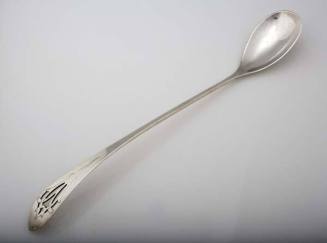
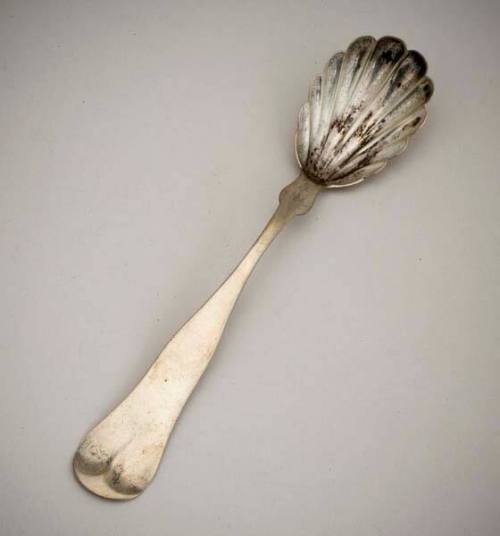
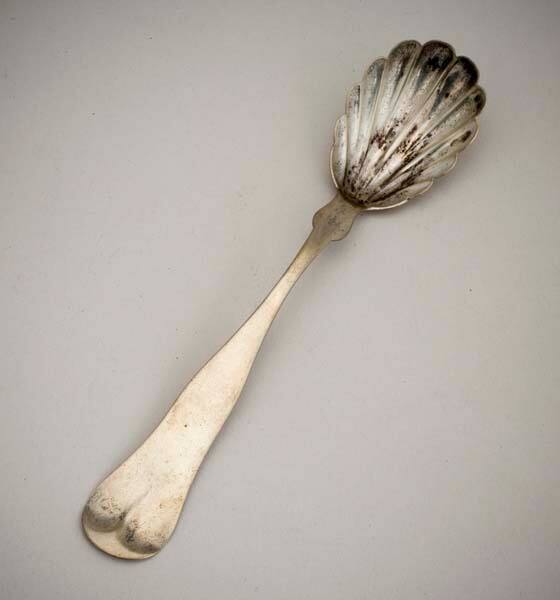
Scalloped spoon
Skip to main content


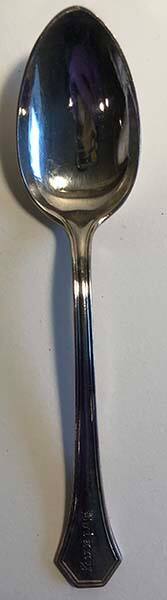
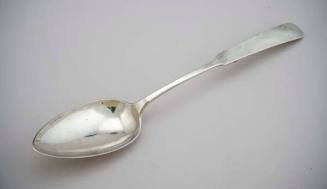
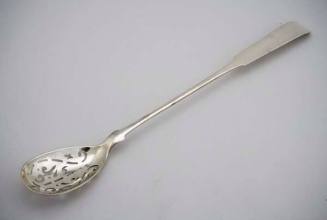
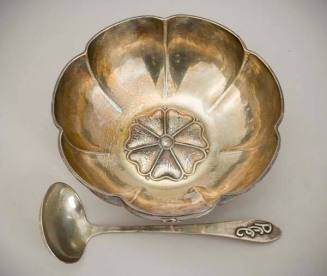
This record is part of an active database and may include information from historic documentation that could be inaccurate or incomplete. We frequently update our records based on ongoing research and review. If you have questions, concerns, or additional information about this object, contact us via this form.
Scalloped spoon
Maker
Amos Sanborn
(b. 1812, Salisbury, New Hampshire – ca. after 1875, Lowell, Massachusetts)
Date19th century
GeographyUnited States, North and Central America
MediumSilver
Dimensionsoverall: 5/8 in. x 6 1/4 in. x 1 3/8 in. (1.6 cm x 15.9 cm x 3.5 cm)
Credit LineGift of Mrs. A. J. Staple (Margaret Noyes Kleinert, Class of 1938)
Object number1972.40.3
Status
On viewRightsCopyright is retained in accordance with U.S. Copyright laws
Photo creditDavis Museum at Wellesley College, Wellesley, MA
More InformationSince the arrival of European settlers in North America, silver has held an important place in the religious, public, and private spheres of the life they created. For nineteenth-century Euro-Americans, silversmithing resonated with romantic notions of the nation’s colonial past, and reflected the cultural value placed on refinement and gentility. By the mid-nineteenth century, traditional techniques of fabricating silver were phased out in favor of mass manufacturing. With the introduction of the commercialized silver-plating process, middle-class households could now afford presentation-worthy pieces for their homes. Decoration in revival styles such as Gothic, Rococo, and Colonial became prevalent. Despite the predominance of large manufacturers, local artisans still produced luxury silverware, often for both public and private ceremonial purposes.
Lucile D. Stein
1915
Object number: 1996.54.2
Lucile D. Stein
1915
Object number: 1996.54.1