The Unequal Lovers
Skip to main content

This record is part of an active database and may include information from historic documentation that could be inaccurate or incomplete. We frequently update our records based on ongoing research and review. If you have questions, concerns, or additional information about this object, contact us via this form.
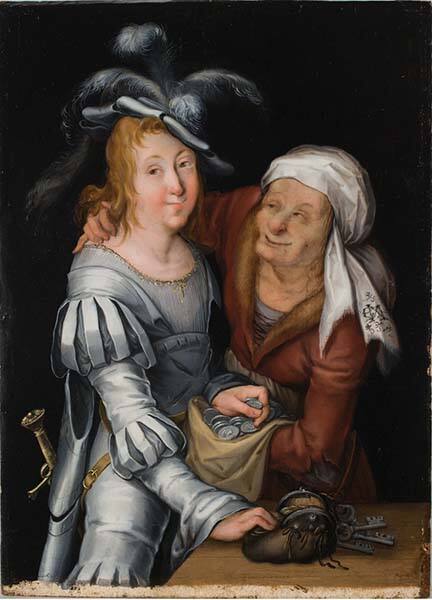
The Unequal Lovers
Makercircle of
Lucas Cranach the Younger
(b. 1515, Wittenberg, Germany – d. 1586, Weimar, Germany)
Date16th century
MediumOil on panel
Dimensions14 1/8 in. x 10 1/4 in. (35.9 cm x 26 cm)
Credit LineMuseum purchase, The Class of 1947 Acquisition Fund
Object number2018.24
Status
On viewProvenancePurchased 10/13/2017 at Christie's, sale 14277 Old Masters; lot no. 187.
RightsCopyright is retained in accordance with U.S. Copyright laws
Photo creditDavis Museum at Wellesley College, Wellesley, MA
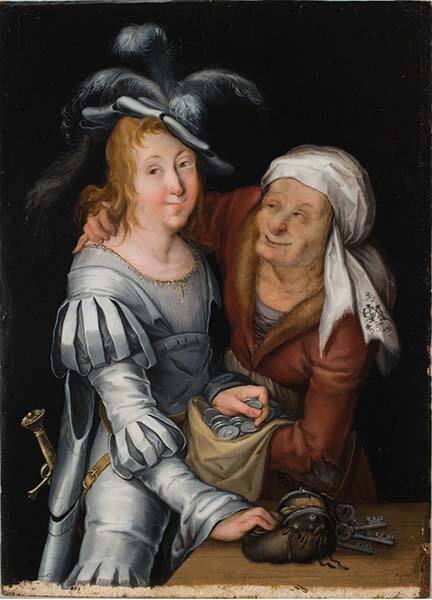
More InformationA popular satirical theme in Northern Europe, the ill-matched couple developed originally in literature and emerged in the visual arts in the fifteenth century. The majority of examples feature an old man courting a young woman, but this panel flips the trope so that an older, masculine woman courts a younger, effeminate man. In most depictions of unequal lovers money is exchanged, underscoring the impropriety of the relationship and implying the match is monetarily motivated. While marriage in the sixteenth century was recognized as a tool to distribute wealth, especially from older spouses to younger partners, it was still believed that couples of a similar age were better suited and more likely to make a love match. As in the Laughing Fool below, contemporary audiences would have found this representation of unconventional characters humorous, and would have understood the implied joke that love is blind.
This label was originally published on the Davis website as a New Acquisition post. The Davis Museum recently purchased a 16th-century painting depicting the motif of Unequal Lovers. A popular satirical theme in Northern Europe, the ill-matched couple developed originally in literature and emerged in the visual arts in the 15th century. The majority of examples feature an old man courting a young woman, as seen in the Ill-Matched Lovers by Quentin Massys at the National Gallery of Art, D.C., but this panel flips the trope so that an older, masculine woman courts a younger, effeminate man. In most depictions of unequal lovers money is exchanged, underscoring the impropriety of the relationship and implying the match is monetarily motivated. While marriage in the 16th century was recognized as a tool to distribute wealth, especially from older spouses to younger partners, it was still a belief that couples of a similar age were better suited and more likely a love match. Contemporary audiences would have found this representation of unconventional characters humorous—the foolish man and the dominant woman.
Lucas Cranach the Elder
ca. 1507-12
Object number: 2016.435
David Lucasafter John Constable
1830-1833
Object number: 2004.85.2
David Lucasafter John Constable
1830-1833
Object number: 2004.85.3
David Lucasafter John Constable
1830-1833
Object number: 2004.85.4
David Lucasafter John Constable
1830-1833
Object number: 2004.85.5
David Lucasafter John Constable
1830-1833
Object number: 2004.85.6
David Lucasafter John Constable
1830-33
Object number: 2004.85.1-6