Mach 4


Mach 4
The Davis Museum was recently gifted a collection of works by artist Jo Sandman, including her painting Mach 4, photography, linen works, and drawings. Born and raised in Boston, Massachusetts, Sandman is a revered figure among New England artists. She began her artistic career in 1951 after a life-changing summer studying painting, drawing, and photography at Black Mountain College with avant-garde artists including Ben Shahn, Harry Callahan, and Aaron Siskind. She earned her undergraduate degree from Brandeis University before continuing her studies with Abstract Expressionist painter Robert Motherwell at Hunter College and at the Hans Hofmann School of Painting in Provincetown, MA. She then earned graduate degrees from UC Berkeley and Harvard University. In addition to maintaining a robust studio practice in Somerville, MA, Sandman taught art at multiple colleges and art institutes, including Wellesley College.
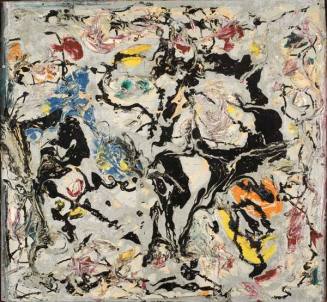
While she worked across media, her early career was defined by Abstract Expressionist paintings. In Mach 4, Jo Sandman used a thick coat of paint to create broad, textured marks across the unprimed canvas. The vivid crimson contrasts with the creamy background, giving the sense of rough spontaneity and raw energy. The North American X-15 rocket-powered airplane exceeded Mach 4, or four times the speed of sound, for the first time on 7 March 1961, and it is likely that this work was inspired by this incredible technological feat. The mixed red and white at the edge could indicate clouds, and the thin lines freely growing in and out of the frame could be interpreted as the trace left by a plane flying past. Intuitively created with painterly strokes, Mach 4 showcases the power of speed—and the machines that chased it.