Yellow Disc
Yellow Disc
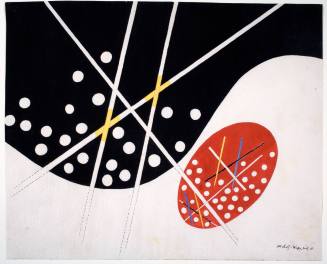
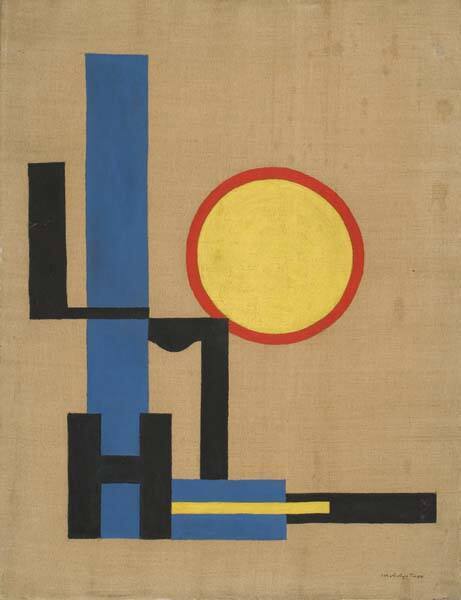
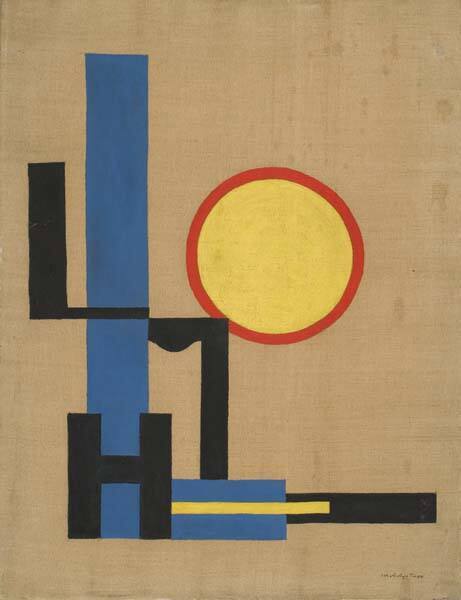
Born László Weisz, Moholy-Nagy served––and was injured––in World War I. After the war, he abandoned legal studies and entered the avant-garde in Budapest, before moving to Berlin. This painting was completed a few years before he joined the faculty at the Bauhaus in 1923. Yellow Disk reflects the influence beyond Russia of Suprematism and Constructivism, evident in the artist’s experimentation with abstraction and typography. The canvas was first exhibited at the Berlin gallery Der Sturm (The Assault), which promoted avant-garde art during the early years of the Weimar Republic (1918–33). Painted on burlap—as canvas was too expensive—the forms in the picture spell out M-O-H-O-L-Y.
In making this gift to Wellesley, the artist’s widow, Sibyl Moholy-Nagy, wrote to John McAndrew, director of the Wellesley College Museum, wryly noting caprices of taste and trend in the formation of art’s history. “Alfred Barr [then director of the Museum of Modern Art] bought two pieces recently,” she wrote. “And so did Philip Johnson. The interest in Constructivism is a curiously fluctuating thing. And with the current revolt against the spit and drip of Abstract Expressionism there seems to be a sort of revival.”