Brillo Box
Skip to main content
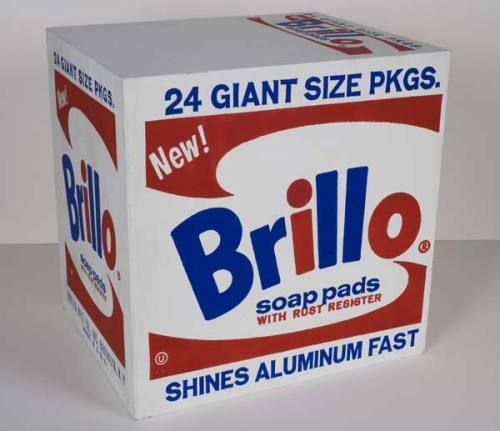
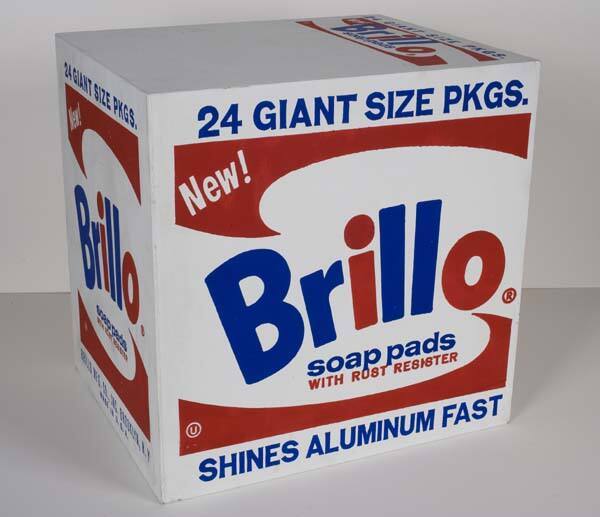
Brillo Box and Cambell’s Tomato Juice Box—constructed of plywood, covered in house paint with screenprinted letters and logos—simulate familiar supermarket goods, elevating the prosaic to aesthetic consideration. Radically unorthodox as “sculpture,” they were initially subject to ridicule. Today, they are iconic examples of Warhol’s genius, in concept, subject, and process.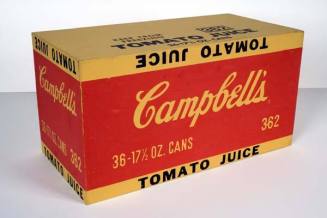



This record is part of an active database and may include information from historic documentation that could be inaccurate or incomplete. We frequently update our records based on ongoing research and review. If you have questions, concerns, or additional information about this object, contact us via this form.
Brillo Box
Maker
Andy Warhol
(b. 1928, Pittsburgh, Pennsylvania – d. 1987, New York, New York)
Date1964
GeographyUnited States, North and Central America
MediumSynthetic polymer paint and screen print ink on wood
Dimensionsoverall: 17 in. x 17 in. x 14 in. (43.2 cm x 43.2 cm x 35.56 cm)
Credit LineMuseum purchase and partial gift of The Andy Warhol Foundation for the Visual Arts, Inc.
Object number1993.25
Status
Not on viewRights© The Andy Warhol Foundation for the Visual Arts, Inc. / Artists Rights Society (ARS), New York
Photo creditDavis Museum at Wellesley College, Wellesley, MA
More InformationTrained at the Carnegie Institute of Technology, Warhol began his career as a commercial artist and illustrator. By the 1960s, in the heyday of Abstract Expressionism in New York, his work cut a different course: figurative, relational, rooted in popular culture, it would later be dubbed “Pop art.” Warhol’s experimentation across media—painting, print, sculpture, drawing, illustration, and film—expanded the field and orientation of art.
Brillo Box and Cambell’s Tomato Juice Box—constructed of plywood, covered in house paint with screenprinted letters and logos—simulate familiar supermarket goods, elevating the prosaic to aesthetic consideration. Radically unorthodox as “sculpture,” they were initially subject to ridicule. Today, they are iconic examples of Warhol’s genius, in concept, subject, and process.