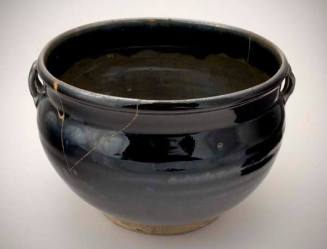
Storage Jar with Loop Handles


Storage Jar with Loop Handles
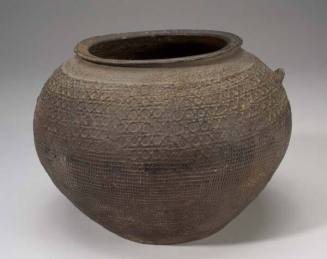
Kaya, a federation that existed from about 42 to 562 C.E. during the Three Kingdoms Period (57 B.C.E.–668 C.E.), was the most important center of early Korean ceramic production. Made from iron-rich clay with traces of natural ash, Kaya ceramics are gray or beige. The objects were fired in closed kilns, unglazed, at approximately 1800° F. Kaya ceramic jars consist of two basic types: the first, made in the third to fourth century, are large and spherical, decorated with cord marks; the other, made in the fifth to sixth century, introduce new shapes and openwork that may have been inspired by early Chinese ceramic and bronze forms––see the two-handled and “placenta” jars on view here.
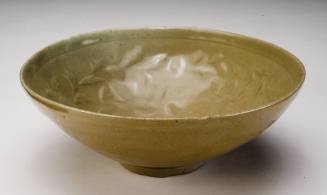
After the Koryŏ Dynasty (918–1392) united the Three Kingdoms in 918, potters began to emulate the Chinese celadon of the Song Dynasty. This type of ceramic was made using fine clay from sedimentary layers, coating the object with glaze, and firing it at a higher temperature (around 2200° F) in a reducing atmosphere, in which the amount of oxygen was controlled to obtain the desired color. The ideal for celadon ceramics was a light and subtle jade tone and a glaze with a fine crackle pattern. Koryŏ celadon is distinguished by its very delicate designs. The motifs on the four bowls in the Davis Museum collection––incised phoenixes, black and white chrysanthemums, and inlaid or mold-impressed leaves and lotus flowers––are auspicious symbols of seasonal cycles, prosperity, peace, and fertility.
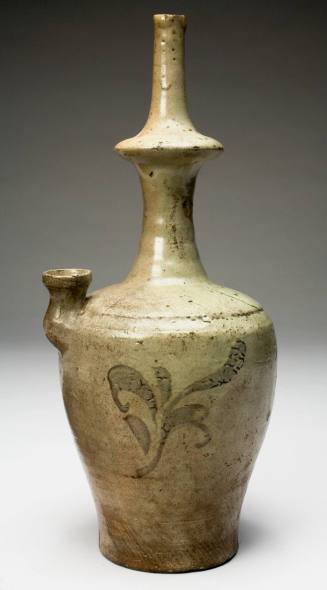
Chinese and Buddhist art and traditions strongly influenced Koryŏ ceramics. One of the objects here, the kundika (chong-byong in Korean), was originally used as a water sprinkler in Indian Buddhist rituals and as an attribute of Avalokiteshvara (Boddhisattva of Compassion––Guanyin in Chinese, Gwan-eum in Korean), who held it to carry the water or nectar of compassion. It became a standard Koryŏ vessel made in both celadon and bronze. Koryŏ bowls and jars were used in royal palaces and Buddhist temples for tea ceremonies, meditation, and enlightenment.