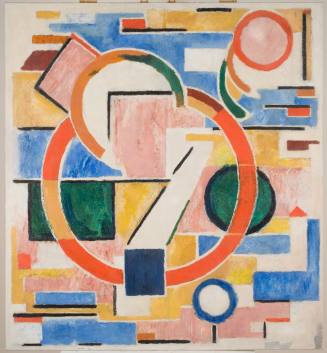
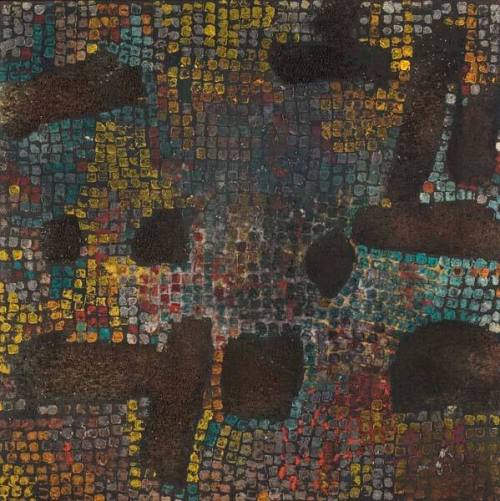
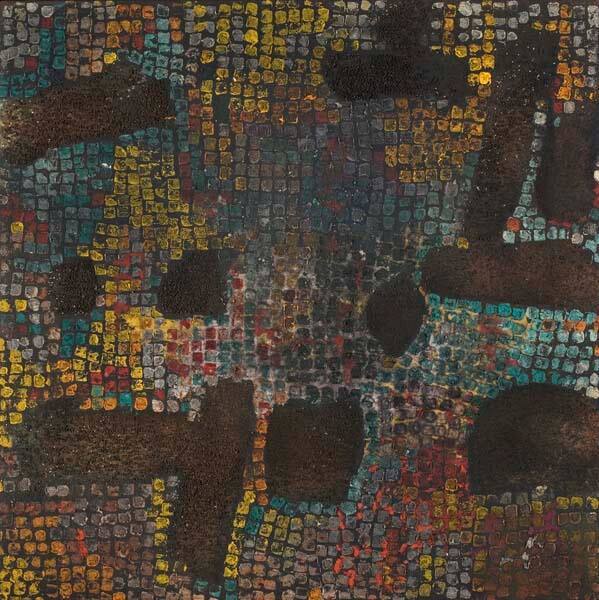
Abstract Composition
Skip to main content
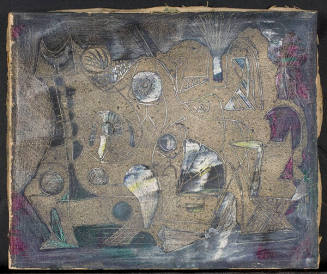
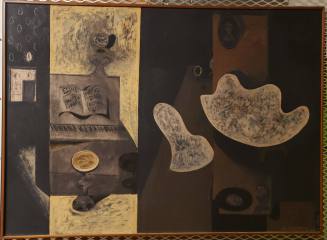
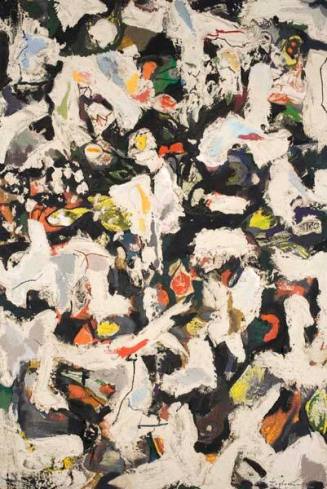
Robert Preusser (artist, former student of Kepes, and subsequent director of the Center for Advanced Visual Studies at MIT) wrote that: “Kepes’ paintings are warm from the sun, cool from twilights, or shaded as a secluded inlet of water. When he touches grains of sand, water-worn, rock forms, a pine branch, he assimilates nature, transforming it into an authentic personal philosophy on canvas, which defines a nature seen and felt by one man in search of an imagery to communicate with all.”




This record is part of an active database and may include information from historic documentation that could be inaccurate or incomplete. We frequently update our records based on ongoing research and review. If you have questions, concerns, or additional information about this object, contact us via this form.
Abstract Composition
Maker
György Kepes
(b. 1906, Selyp, Hungary – d. 2001, Cambridge, Massachusetts)
MediumOil and sand
Dimensionsoverall: 30 in. x 30 in. (76.2 cm x 76.2 cm)
Credit LineGift of Mrs. Irving Sobin
Object number1963.12
Status
Not on viewRightsCopyright is retained in accordance with U.S. Copyright laws
Photo creditDavis Museum at Wellesley College, Wellesley, MA
More InformationA prolific and polymathic artist, designer, author, and educator, Kepes was trained in painting at the Royal Academy of Fine Art in Budapest and there began to experiment with unconventional photographic techniques like photograms. On moving to Berlin, he met the circle of László Moholy-Nagy and members of the Bauhaus; he immigrated to the U.S. in 1937 to lead the “Light and Color Department” at the New Bauhaus in Chicago, and later established the Center for Advanced Visual Studies at MIT where he advocated for connections across art, science, and technology.
Robert Preusser (artist, former student of Kepes, and subsequent director of the Center for Advanced Visual Studies at MIT) wrote that: “Kepes’ paintings are warm from the sun, cool from twilights, or shaded as a secluded inlet of water. When he touches grains of sand, water-worn, rock forms, a pine branch, he assimilates nature, transforming it into an authentic personal philosophy on canvas, which defines a nature seen and felt by one man in search of an imagery to communicate with all.”