Landscape
Skip to main content
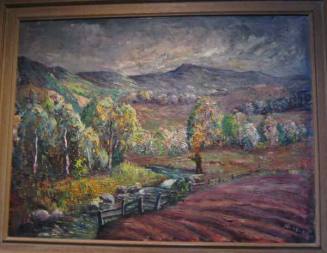
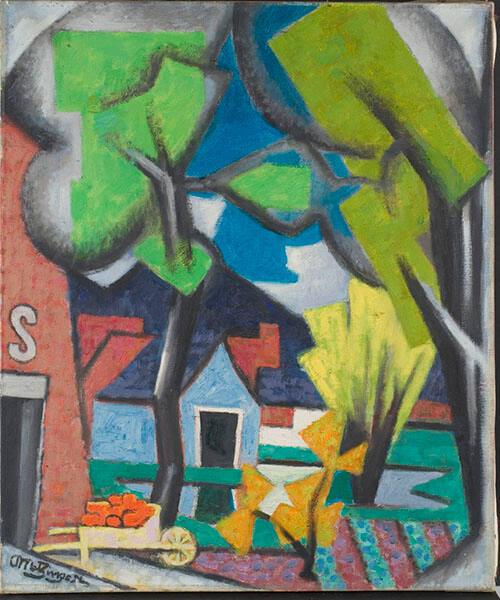
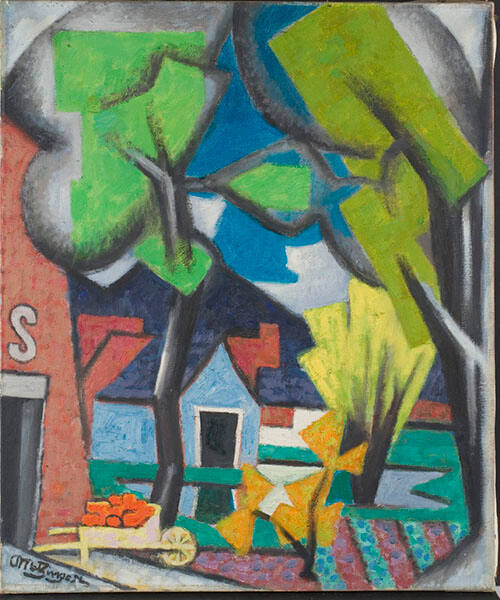
Metzinger’s exuberant color and fracturing of form and space lend a modernist zing to a subject that was undoubtedly bucolic and familiar. The greens in the trees, for example, laid on in blocks and shapes, both articulate and move fancifully beyond their referents, toward an expanded sense of “tree-ness.” The picture becomes kinetic, ablaze with movement, and it calms only at the front left corner, with the sweetly descriptive treatment of the apple barrow. Metzinger’s work was among the 650 confiscated paintings included in the 1937 Degenerate Art exhibition organized by the Nazi Party in Munich.

This record is part of an active database and may include information from historic documentation that could be inaccurate or incomplete. We frequently update our records based on ongoing research and review. If you have questions, concerns, or additional information about this object, contact us via this form.
Landscape
Maker
Jean Metzinger
(b. 1883, Nantes, France – d. 1956, Paris, France)
Date1947-50
MediumOil on canvas
Dimensions21 5/8 in. x 18 in. (54.9 cm x 45.7 cm)
Credit LineBequest of Lotte Adler Fields (Class of 1944)
Object number2014.12
Status
Not on viewRightsCopyright is retained in accordance with U.S. Copyright laws
Photo creditDavis Museum at Wellesley College, Wellesley, MA
More InformationAn early proponent of Divisionism, Metzinger was later associated with les fauves (wild beasts), derided for their unnatural color and unconventional paint handling. With Albert Gleizes, he was one of the first artists to theorize Cubism, through the manifesto Du “cubisme”, published in 1912. This influential treatise pushed painting to capture the dynamic multiplicity of modernity—beyond single-point perspective to the experience of rapid change. Metzinger was among the art stars of the avant-garde, exhibiting with Georges Braque, Robert Delaunay, Sonia Delaunay-Terk, André Derain, Kees van Dongen, Férnand Leger, Pablo Picasso, and George Rouault, among others.
Metzinger’s exuberant color and fracturing of form and space lend a modernist zing to a subject that was undoubtedly bucolic and familiar. The greens in the trees, for example, laid on in blocks and shapes, both articulate and move fancifully beyond their referents, toward an expanded sense of “tree-ness.” The picture becomes kinetic, ablaze with movement, and it calms only at the front left corner, with the sweetly descriptive treatment of the apple barrow. Metzinger’s work was among the 650 confiscated paintings included in the 1937 Degenerate Art exhibition organized by the Nazi Party in Munich.