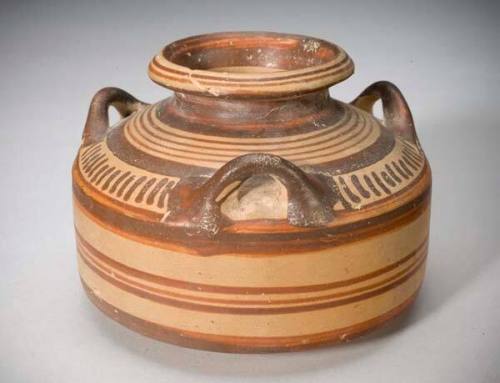
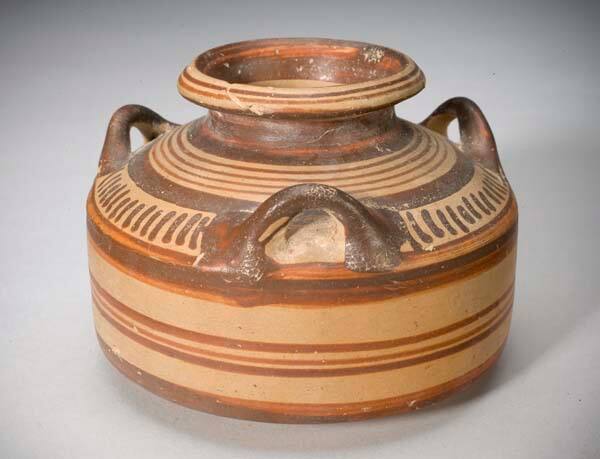
Pyxis

Skip to main content
This record is part of an active database and may include information from historic documentation that could be inaccurate or incomplete. We frequently update our records based on ongoing research and review. If you have questions, concerns, or additional information about this object, contact us via this form.

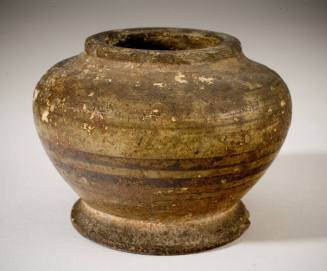
Pyxis

Maker
DateMycenaean period, ca. 1300 B.C.E.
GeographyGreece, Europe
MediumTerracotta
Dimensionsoverall: 2 5/8 in. x 3 3/4 in. x 3 3/4 in. (6.7 cm x 9.5 cm x 9.5 cm)
Credit LineMuseum purchase through funds from the Estate of Jane H. Wengren (Class of 1935)
Object number1970.28
Status
On view
ProvenanceProf. John Oddy.
RightsCopyright is retained in accordance with U.S. Copyright laws
Photo creditDavis Museum at Wellesley College, Wellesley, MA
More Information

Mycenaean Greece and Cyprus

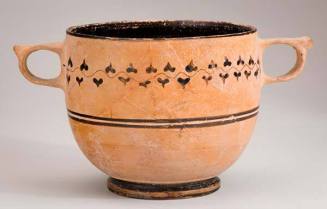
Mycenaean culture dominated mainland Greece and much of the Aegean for five centuries (1600–1100 B.C.E.). Regional kingdoms were typified by large fortified palatial centers at sites like Mycenae and Tiryns that were identified by later Greeks with the heroes of the Trojan War. Mycenaean pots often imitated objects made of precious metals but were decorated in different styles. Here, spirals, scales, shells, and marine creatures are rendered as schematic and abstract patterns around the body of the vessels.


The exchange of both bulk commodities and luxury goods brought Greece into a broader Mediterranean network during the Mycenaean era and continuing into the Geometric period. The influence of Greek pottery decoration can also be seen in these vessels from Cyprus, an important crossroads of trade routes between the Near East and the Western Mediterranean throughout antiquity. The migration of people from the Aegean to the eastern Mediterranean also fostered the cultural and stylistic development of Cyprus for many centuries.
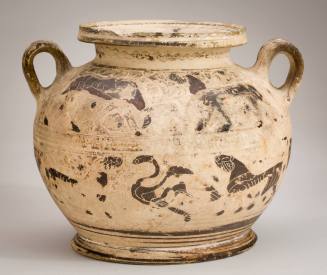
Pyxis
Greek
Corinthian period, 600-575 B.C.E.
Object number: 1950.22c
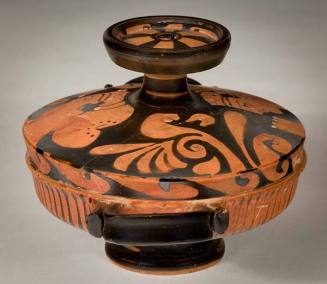
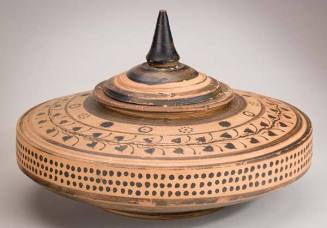
Pyxis and lid
Greek
4th century B.C.E.
Object number: 1973.57
Pyxis
Greek
7th century B.C.E.
Object number: 1950.22.3
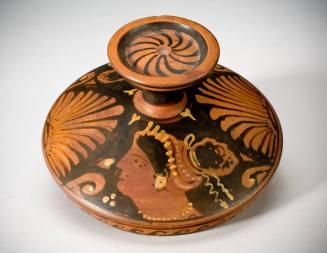
Cover of a pyxis: Heads of two women
Greek
Hellenistic period, 4th-3rd century B.C.E.
Object number: 1954.1b
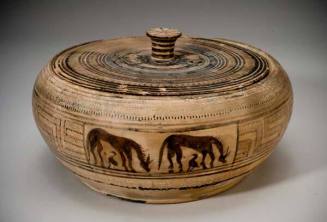
Flat Pyxis
Greek
Middle Geometric II period, ca. 750 B.C.E.
Object number: 1971.18a-b
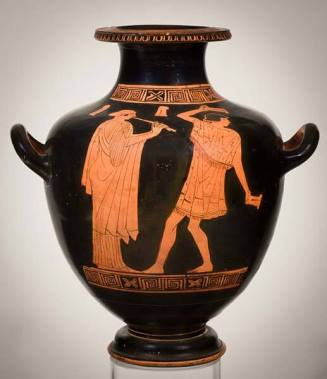
Red-figure hydria: Musician and dancer
Greek
Classical period, ca. 420 B.C.E
Object number: 2009.3
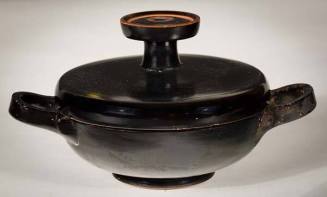
Lekanis
Greek
Classical period, late 5th century B.C.E.
Object number: 1973.58a-b
Cup
Greek
Archaic period, 6th-5th century B.C.E.
Object number: 1986.198
Red-figure lekanis
Greek
Late Classical period, ca. mid-4th century B.C.E.
Object number: 2009.4a-b
Red-figure bell krater: Dancer / Youths
Greek
Classical period, ca. 400 B.C.E.
Object number: 2009.2
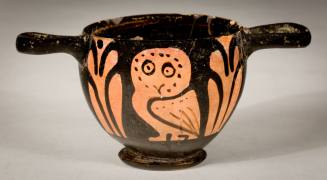
Red-figure skyphos: Owl
Greek
Classical period, 5th century B.C.E.
Object number: 1954.1c
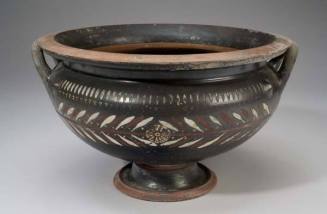
Gnathian ware bowl
Greek
3rd century B.C.E.
Object number: 1976.39